

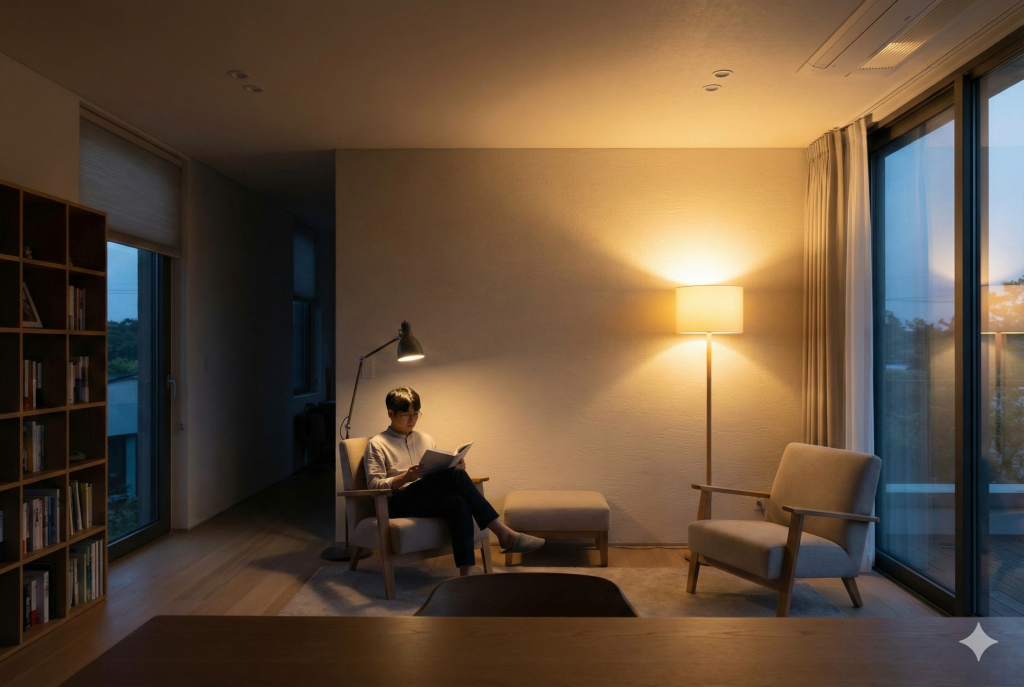
If you are writing, drawing, or cooking, you must choose direct lighting to provide the precision focus your eyes need. If you are watching TV or relaxing, you should switch to indirect lighting to reduce visual strain. If you want to avoid eye fatigue during long work hours, the secret is not choosing one or the other, but perfectly balancing the path the light travels before reaching your eyes.
Technical Traffic Lights: Why Light Direction Changes Everything
The most critical factor in your visual comfort is not the intensity of the bulb (lumens), but the direction the light travels.
- Direct Lighting: The light travels straight from the bulb to your task surface. It delivers focused, high-contrast illumination but carries a higher risk of harsh shadows.
- Indirect Lighting: The light reflects off walls or ceilings before reaching your eyes. It creates softer, evenly distributed light that naturally reduces visual strain, but it lacks the contrast needed for detail work.
Your visual system reacts far more to contrast and angle than to raw brightness. This is exactly why two rooms with the exact same lux level can feel completely different in terms of comfort.
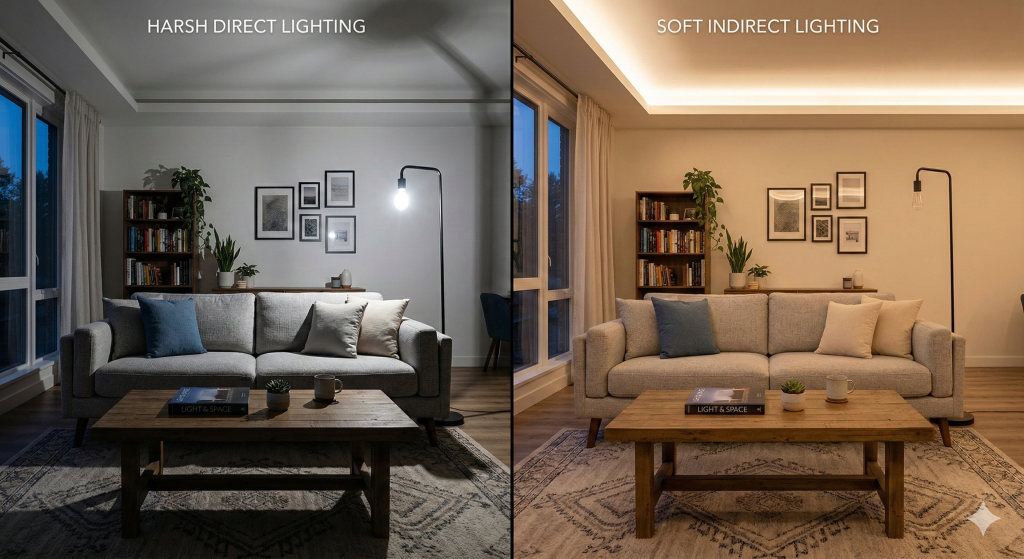
Direct vs Indirect Lighting: Side-by-Side Comparison
To build the perfect workspace or living area, you need to understand how these two lighting types behave in the real world:
| Factor | Direct Lighting | Indirect Lighting |
| Light Path | Straight to the task surface | Reflected from walls or ceilings |
| Contrast | High, well-defined | Low, diffused |
| Shadows | Sharp, distinct edges | Soft, blended, or non-existent |
| Glare Risk | Higher (if poorly aimed) | Naturally reduced |
| Best Use Cases | Reading, writing, detailed crafting | Relaxation, TV watching, ambient fill |
The Lux Ratio Rule (Why Comfort Needs Contrast)
A key technical concept for a healthy setup is the Lux Ratio. For comfortable vision, your primary task surface (like your notebook) should be about 3× brighter than the surrounding area. This 3:1 ratio provides enough contrast to read clearly without forcing your eyes to constantly dilate and adapt.
Too little contrast makes text feel washed out, while too much contrast creates immediate eye strain.
Why “Bright” Does Not Mean “Clear”
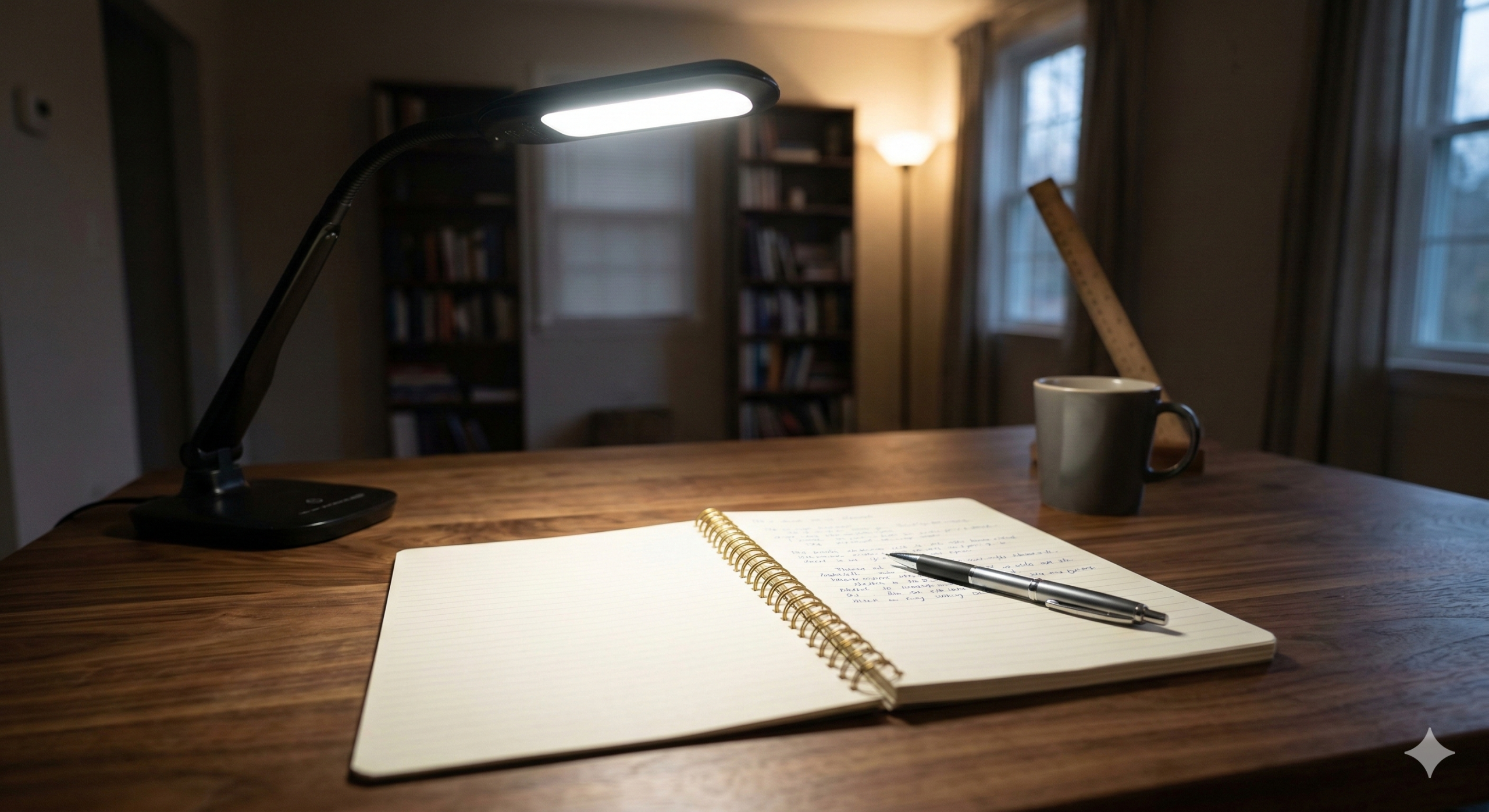
When people struggle to see their work, they usually buy a brighter bulb. But clarity is actually governed by two technical factors:
- Contrast Ratio: Your eyes perform best when the task area is 2–4× brighter than its surroundings. If you only use direct lighting in a dark room, the contrast is too high, leading to fatigue.
- UGR (Unified Glare Rating): Glare is about angle, not just brightness. When direct light hits your eyes or reflects off a glossy desk mat, it spikes the UGR and causes tension headaches. Indirect lighting naturally lowers the UGR because the light rays are scattered before reaching your retinas.
Editor’s Note: The 1-Week Home Office Experiment
What I assumed: I thought that indirect lighting was universally “better” and “softer” for my eyes. So, I replaced all my direct desk lamps with LED strips bouncing light off the walls.
What my hands-on test revealed: I worked for an entire week using only wall-bounced light while editing documents. By Day 3, my eyes felt incredibly tired and unfocused, and the text on my desk looked “flat” and washed out.
The Corrected Result: I added a small, direct task lamp back onto my desk. The eye strain disappeared almost instantly. The lesson? Comfort without contrast reduces clarity. Good lighting isn’t just about making things softer—it’s about balancing direct focus with indirect comfort.
Final Thoughts: How to Set Up Your Space
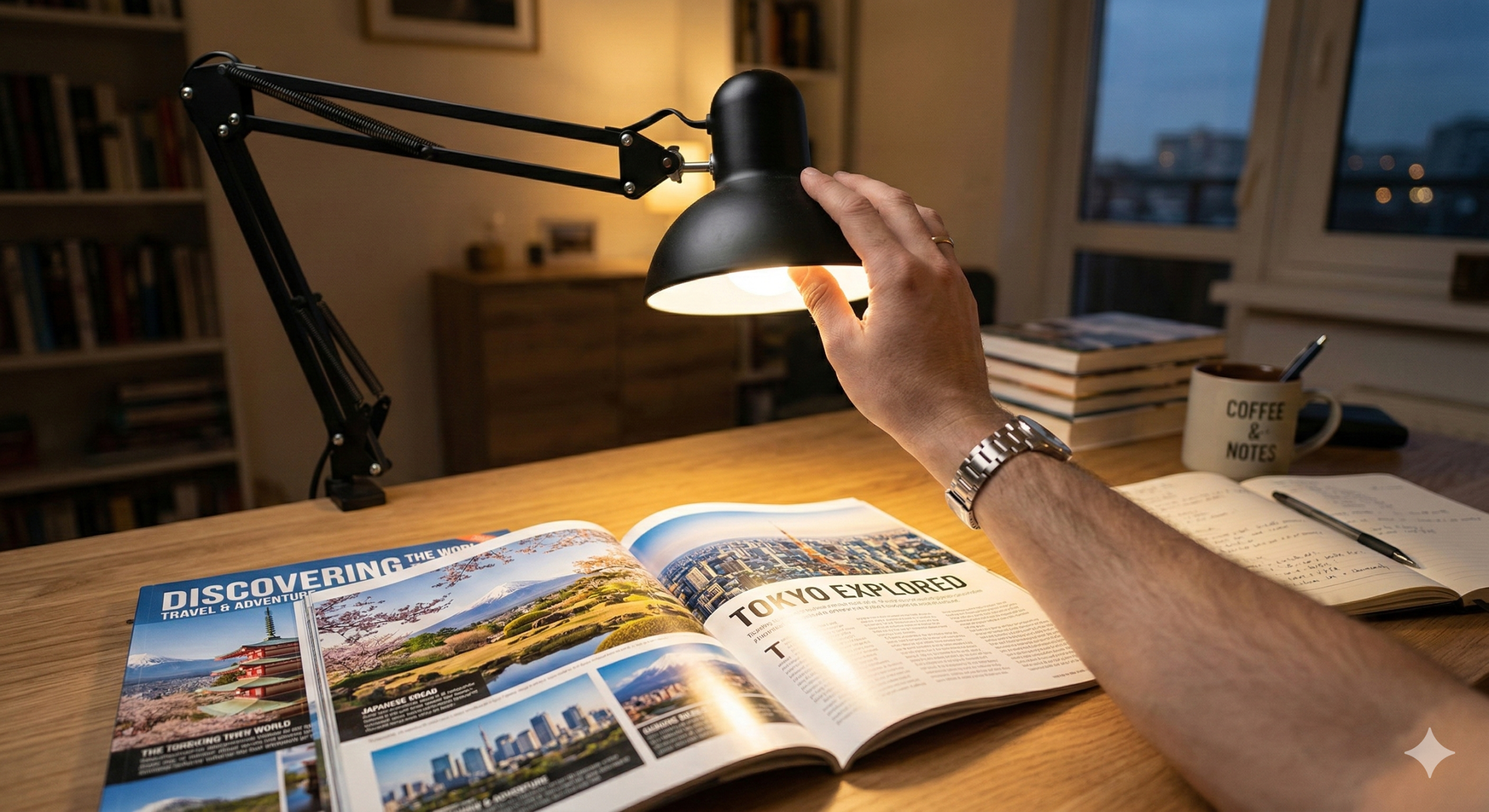
You don’t need expensive equipment to get your lighting right. Just follow this simple, actionable rule:
- Use direct light for the task (what your hands are actually doing).
- Use indirect light for the room (what your eyes perceive in your peripheral vision).
- Keep your background ambient brightness at 30–40% of your main task brightness.
When your light direction matches your visual demand, comfort and clarity naturally follow.
FAQ
Is direct lighting bad for your eyes? No. Direct lighting is absolutely necessary for detailed tasks. It only becomes harmful when the bulb shines directly into your line of sight or creates harsh glare on your desk surface.
Can I use only indirect lighting for reading? You can, but it will likely cause visual fatigue over long periods. Reading requires sharp contrast to distinguish letters from the page, which indirect light alone often fails to provide.
What is the best lighting setup for computer work? Indirect lighting placed behind or around your screen (bias lighting) works best. Because computer monitors emit their own direct light, adding a harsh direct desk lamp often causes severe screen reflections.