

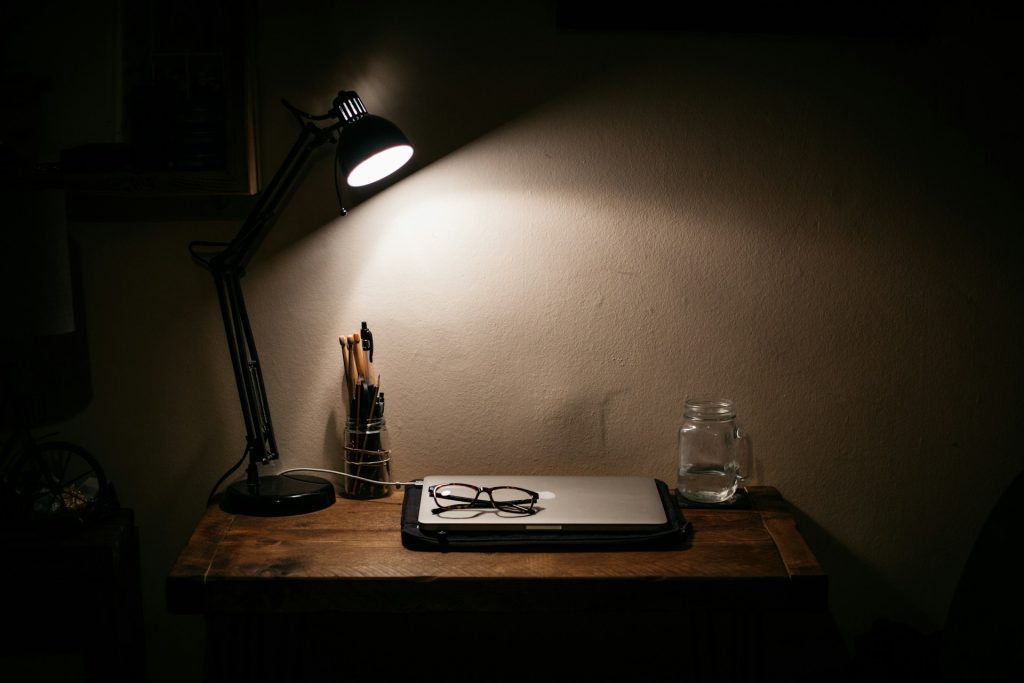
You have likely stood in the lighting aisle of a hardware store, staring at a wall of boxes, feeling a mounting sense of frustration. For decades, we relied on a simple number—60 watts—to tell us exactly what kind of light we were getting. Today, that number is a lie. It measures energy, not brightness. If you want to stop guessing and start controlling the atmosphere of your home, you have to master the lumen.
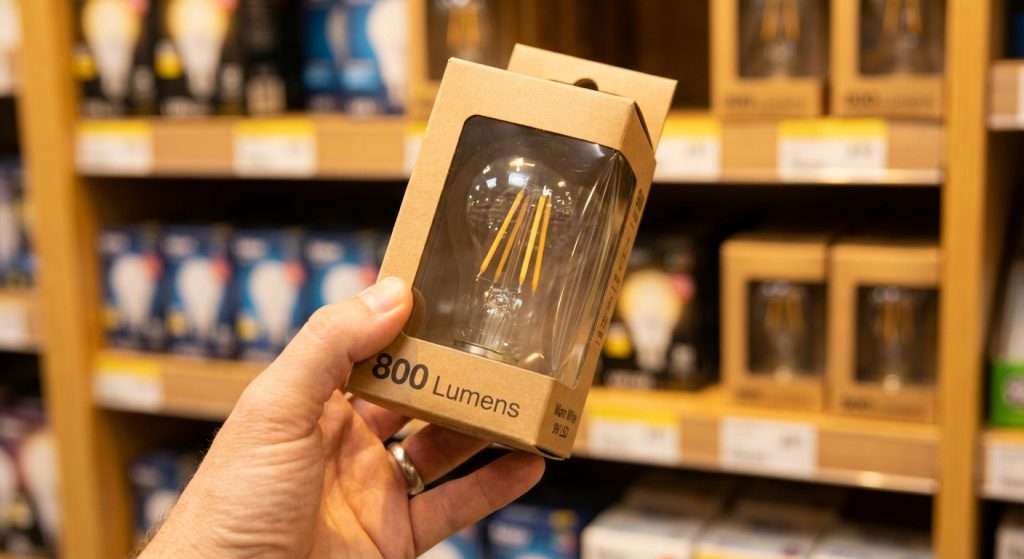
When you replace an old 60-watt incandescent, you aren’t looking for a “60-watt LED.” You are looking for 800 lumens. If your kitchen feels like a cave or your home office is giving you eye strain, the solution isn’t “more watts”—it is a higher lumen count. Lumens represent the total volume of visible light a lamp produces. It is the most honest number on the box, and it is the only one that truly dictates how well you can see.
Technical Traffic Lights
In the world of lighting design, a lumen is a measurement of luminous flux. To put it simply, it is the total amount of visible light emitted by a source in every direction. It does not account for how much electricity the bulb sucks from your wall, nor does it tell you how focused the beam is. Instead, it measures what the human eye actually perceives as brightness.
This measurement is “weighted” to match human biology. Our eyes are not equally sensitive to all colors of light. We are far more sensitive to green and yellow wavelengths than we are to deep reds or blues. Because of this, two light sources can emit the exact same amount of radiant energy, but if one is tuned to the green-yellow spectrum, it will have a significantly higher lumen rating. This is why “cool white” bulbs often feel more intense than “warm white” bulbs, even when their raw energy output is identical.
The shift from watts to lumens is a shift from measuring input to output. When you buy an old-fashioned incandescent bulb, most of the energy you pay for is wasted as heat. An LED is a precision instrument that converts the vast majority of its electrical power directly into visible light. When a package says 800 lumens, it is giving you the final result—the actual “product” you are buying—rather than just the “cost” of running it.
Lumens are not watts, and this is where most buying mistakes happen
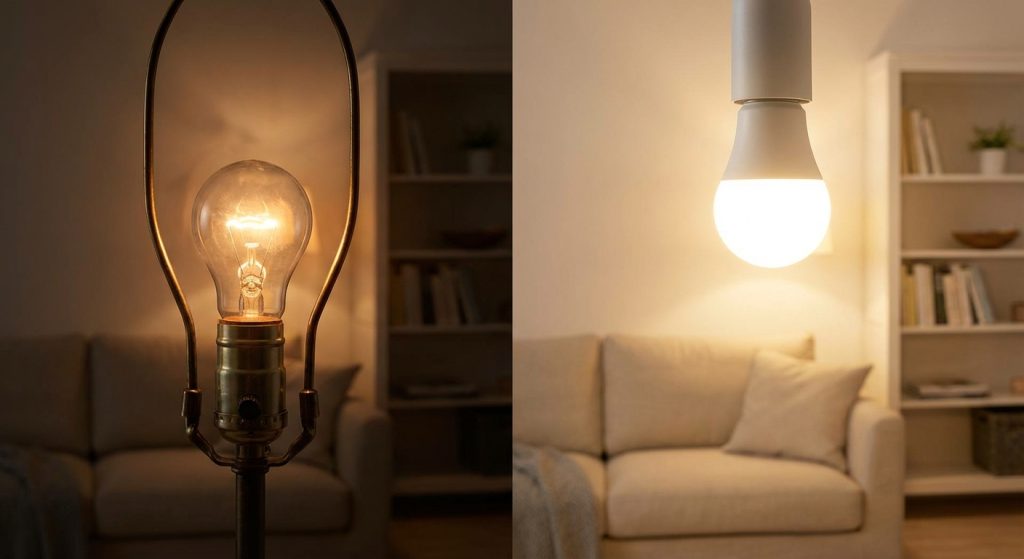
The “Wattage Trap” is the single biggest reason people end up with poorly lit homes. A watt is a unit of power consumption; it tells you how much your utility company is going to charge you. For nearly a century, we used watts as a shortcut for brightness only because the technology was stagnant. Since every 60-watt bulb used the same tungsten filament, they all produced roughly the same 800 lumens.
That shortcut is now broken. In the modern market, a 9-watt LED from one brand might produce 800 lumens, while a cheaper, less efficient 9-watt LED from another brand might only produce 600. If you shop by watts, you are shopping for the electricity bill, not the light. This is why we see so many “dim” LED upgrades; homeowners buy a low-wattage bulb expecting a certain brightness and find themselves squinting in the dark.
The metric you actually want to look for is luminous efficacy, expressed as lumens per watt (lm/W). This is the “miles per gallon” of the lighting world. A high-quality LED might deliver 100 lm/W, whereas an old incandescent struggled to hit 15 lm/W. By focusing on the lumen count first, you lock in your desired brightness. Only then should you look at the wattage to find the most efficient bulb that can reach that target.
How light output is measured and why room results still vary
Manufacturers arrive at these lumen numbers using highly controlled laboratory equipment. The most common tool is the integrating sphere—a large, hollow globe coated with a highly reflective white material. The bulb is placed inside, and the sphere captures every single photon emitted in every direction to calculate the total flux.
However, your living room is not an integrating sphere. Once you take that 800-lumen bulb and put it inside a thick fabric lampshade, you might lose 30% of that light instantly. If you put it in a recessed “can” light in the ceiling, much of the light is trapped inside the fixture itself. This is known as fixture loss. A bulb can be objectively bright on the box but feel subjectively dim in your home because of the environment.
Furthermore, the Color Rendering Index (CRI) and Color Temperature (K) play a massive role in how “bright” a lumen feels. A 1,000-lumen bulb with a low CRI will make colors look muddy and gray, which our brains often interpret as “dimness.” Conversely, a high-CRI bulb makes colors pop, creating a sense of clarity that feels brighter even if the lumen count is the same. Dark walls, heavy carpets, and high ceilings also “eat” lumens, requiring you to over-spec your brightness to achieve the same visual comfort.
I used to assume that if I doubled the lumens, I would double the perceived brightness in the room. I took an 800-lumen bulb and a 400-lumen bulb and tested them in the exact same floor lamp, measuring the results with a professional lux meter at table height. What my hands-on test revealed was a reality check: while the meter showed double the light energy, my eyes didn’t see a “2x” increase. Because human perception is logarithmic, you often need a much larger jump in lumens than you think to make a room feel significantly brighter. Don’t be afraid to go higher than the “equivalent” suggests.

Concept Break
Lumens tell you how much light leaves the bulb. They do not tell you where that light goes.
This is the fundamental distinction between luminous flux (lumens) and illuminance (lux). If you have a high-lumen bulb but a poor fixture design, you are wasting the light you paid for. To get the most out of your purchase, you must pair the right lumen count with the right beam angle and fixture transparency.
Actionable Decision Framework
To stop the guesswork, use a “Lumen-First” strategy for every room in your house. Do not look at the “wattage equivalent” until you have verified the raw lumen number.
- For Ambience (Bedrooms, Hallways): Aim for 250 to 450 lumens. This provides enough light to navigate safely without destroying your evening relaxation or triggering “blue light” alertness.
- For General Living (Living Rooms, Dining Areas): The 800-lumen bulb is the gold standard here. It provides enough punch for reading and socializing without feeling sterile.
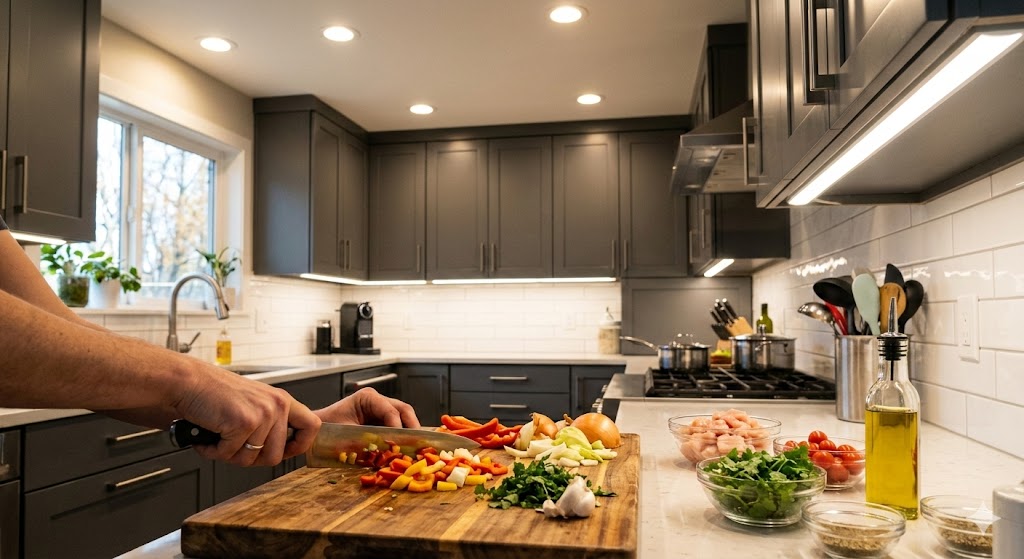
- For Task Lighting (Kitchens, Home Offices, Bathrooms): You need clarity. Look for bulbs in the 1,100 to 1,600 lumen range. In these spaces, you are performing detailed work like chopping vegetables or reading fine print, and “standard” brightness often falls short.
Remember that environment dictates requirements. If you have dark navy walls, those walls are absorbing light rather than reflecting it. In a dark-colored room, you may need to increase your lumen target by 20-30% just to achieve the same “feel” as a white-walled room. If you are using a directional fixture, like a spotlight, you can often get away with fewer lumens because all the light is being forced toward one specific task rather than scattering across the ceiling.
FAQ Module
What is a lumen in simple terms?
A lumen is the total “amount” of light coming out of a bulb. Think of it like water coming out of a faucet: the wattage is the size of the pipe (the energy used), and the lumens are the actual gallons of water filling your bucket (the light you get).
How many lumens do I need to replace a 60-watt bulb?
To match the brightness of a classic 60-watt incandescent bulb, you should look for an LED that produces approximately 800 lumens. If the bulb is going behind a heavy or dark shade, you might want to step up to 1,000 lumens to compensate for the light lost through the material.
Is higher wattage brighter on LED bulbs?
Not necessarily. Because different manufacturers use different qualities of LED chips and drivers, one 10-watt bulb might be significantly brighter than another 10-watt bulb. Always ignore the wattage when judging brightness and look specifically for the lumen rating on the “Lighting Facts” label.
How do manufacturers measure light output from a bulb?
They use specialized laboratory equipment like integrating spheres (which measure total light in all directions) and goniophotometers (which measure how light is distributed at different angles). These tests are done in “clean” environments, so your real-world results will usually be slightly lower once you factor in your fixtures and room colors.
If you find that your current lighting feels “off,” the solution is rarely to just buy more bulbs. Instead, look at the lumen counts of your existing lamps. Upgrading a few key 400-lumen bulbs to 800 or 1,100-lumen versions can transform a dingy room into a vibrant, functional space. Start by identifying the “dark spots” in your daily routine, check the lumen ratings on your current bulbs, and make the switch to a higher output—your eyes will thank you.