


If you are buying a desk lamp for studying, reading, or design work, then you must choose a fixture with a CRI of 90 or higher. If you only look at lumens and ignore CRI, your printed documents, skin tones, and workspace will look dull and washed out, leading to faster eye fatigue.
Technical Traffic Lights: What Is CRI?
CRI (Color Rendering Index) is a technical measurement on a scale from 0 to 100 that indicates how accurately a light source reveals the true colors of objects compared to natural sunlight.
- CRI 100: Colors look perfectly natural, exactly as they would under pure midday sunlight.
- Lower CRI (Under 80): Colors appear grayish, unnatural, or heavily tinted.
When you buy a standard LED bulb, it usually falls somewhere between 70 and 95 on the CRI scale. A low-CRI light might technically be very bright (high lumens), but because it cannot render the full spectrum of colors, your eyes have to work harder to distinguish contrast, which accelerates visual fatigue.

CRI 80 vs CRI 90: What’s the Real Difference?
When shopping for desk lamps, you will most commonly see claims of “CRI 80+” or “CRI 90+”. The difference between these two numbers is massive when it comes to long-term visual comfort.
CRI 80: The Acceptable Standard
CRI 80 is the bare minimum for indoor environments. It is completely fine for hallways, closets, or general ambient room lighting where you aren’t performing detailed tasks. However, under CRI 80, reds and wood tones often look slightly muted.
CRI 90+: The Workspace Requirement
CRI 90 or higher is considered “high color rendering.” Under this light, text contrast is significantly sharper, and objects look vivid and true to life. If you spend hours at a desk, a CRI 90+ lamp actively reduces eye fatigue by making it easier for your brain to process visual information.
Editor’s Note: The Wood Desk Test
What I assumed: I bought a cheap LED desk lamp that was extremely bright (800 lumens) and assumed the “washed out” look of my workspace was just how cheap LEDs looked.
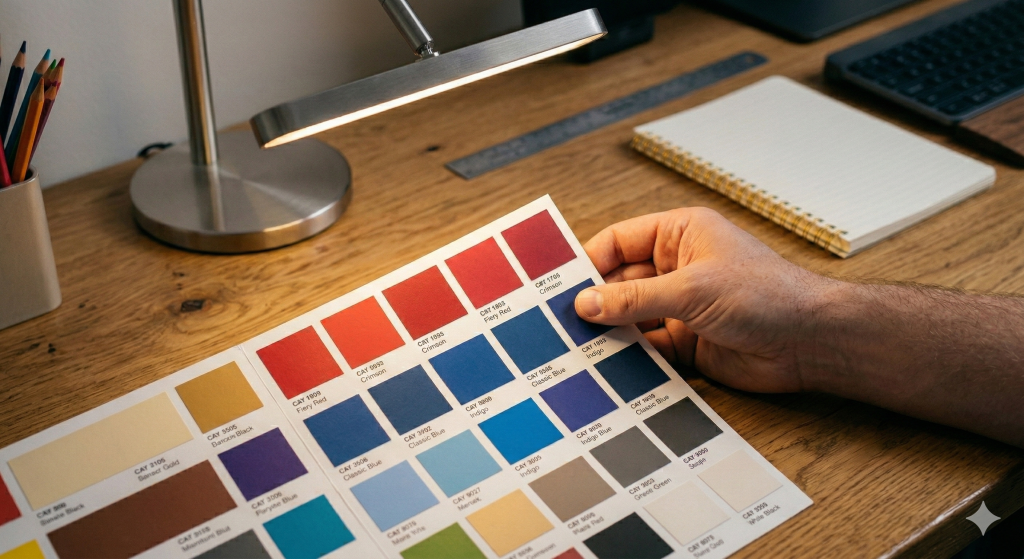
What my hands-on test revealed: I placed my hand and a colorful notebook on my natural walnut wood desk. Under the cheap CRI 75 lamp, my skin looked sickly and grayish, and the warm tones of the wood were completely flattened. I swapped the bulb for a CRI 95+ LED. Instantly, the rich reds and browns of the wood popped, my skin tone looked natural, and the contrast between the ink and the paper in my notebook was drastically sharper.
The Corrected Result: Brightness (lumens) gives you volume, but CRI gives you clarity. A high-CRI lamp transforms a sterile workspace into a comfortable, visually engaging environment.
What CRI Should You Choose? (Quick Guide)
To stop the guesswork, match the CRI rating to the specific room and task. Remember, higher CRI bulbs often cost slightly more, so place them where they matter most:
| Usage Area | Recommended CRI | Why It Matters |
| Reading / Studying / Desk Work | 90+ | Maximizes text contrast and prevents visual fatigue during long sessions. |
| Photography / Art / Design | 95+ | Ensures absolute color accuracy for mixing paints or editing photos. |
| Living Room / Kitchen | 85–90 | Keeps food looking appetizing and skin tones looking natural. |
| Hallways / Garages | 80+ | Basic visibility is the only requirement; color accuracy is not critical. |

FAQ
Does higher CRI always mean better lighting? Not for every situation. High CRI is critical when you need accurate colors, spend long hours reading, or want to enhance the aesthetic of a room. But for utility spaces like a garage or outdoor security lights, chasing a CRI of 95 is a waste of money.
Why does my high-lumen desk lamp make my eyes hurt? If your lamp is very bright but has a low CRI, your eyes struggle to resolve color contrast. This forces your visual system to work harder, leading to tension headaches and fatigue. Upgrading to a CRI 90+ lamp with a proper diffuser usually solves this problem.
Is CRI 100 possible with LED lights? Standard LEDs cannot reach a perfect 100 (which is reserved for sunlight and halogen/incandescent bulbs). However, premium LEDs can now achieve CRI 97 or 98, which is virtually indistinguishable from natural sunlight to the human eye.