

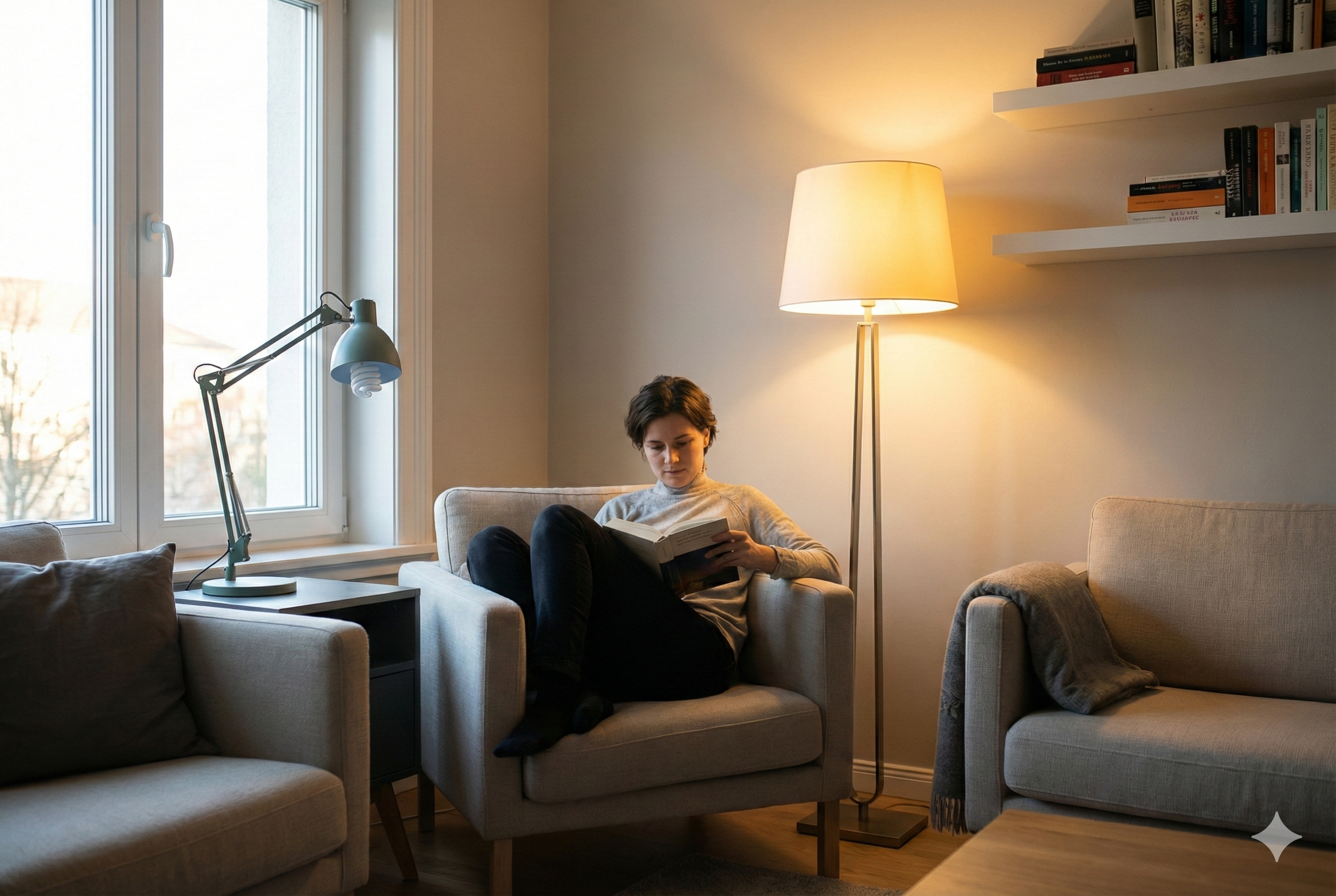
If you are settling in for a long reading session or winding down before bed, you must use a warm light (2700–3000K) to reduce visual tension and protect your sleep cycle. If you need short-term focus, high alertness, or are studying complex textbooks during the day, a cooler light (4000–5000K) will provide the sharpest contrast. The right choice depends entirely on how long and when you are reading, not just how bright the bulb is.
Technical Traffic Lights: How Light Color Affects Reading Comfort
Color temperature affects far more than just the mood of a room—it directly changes how hard your ocular muscles need to work.
- Warm Light (Lower Kelvin): This spectrum produces less blue light, which actively reduces visual tension. It is significantly easier for your eyes to tolerate over long, uninterrupted periods.
- Cool Light (Higher Kelvin): This spectrum increases the contrast between the black ink and the white page, making text appear sharper. However, this high-energy light can cause rapid visual fatigue if used for hours on end.
Your eyes do not just respond to raw brightness; they respond to contrast, spectral balance, and exposure time. This is exactly why the same paperback novel can feel perfectly comfortable to read under one desk lamp, but completely exhausting under another.
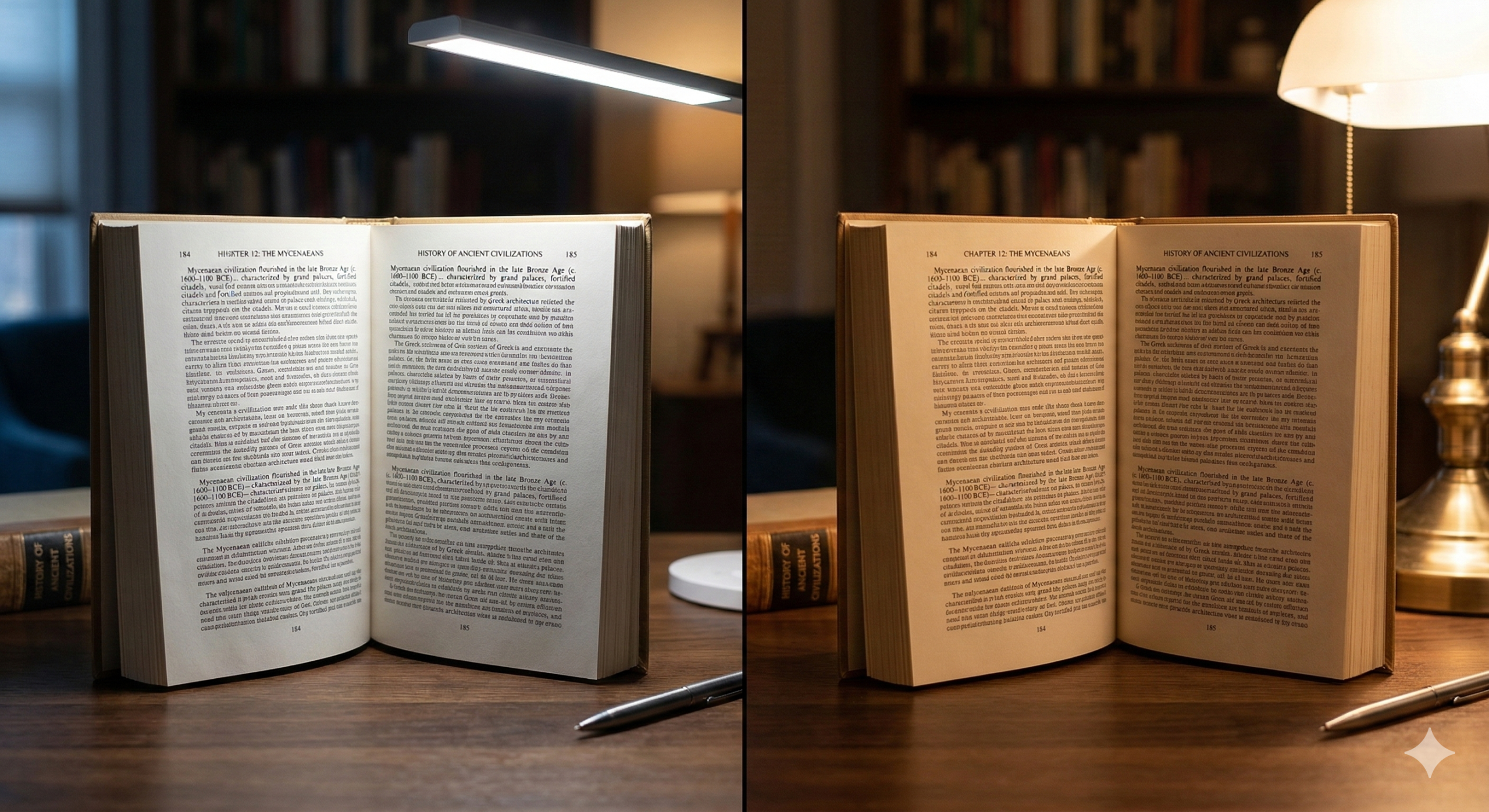
Warm vs Cool Light for Reading: Key Differences
To optimize your study or relaxation space, you need to match the color temperature to your specific endurance needs:
| Factor | Warm Light (2700–3000K) | Cool Light (4000–5000K) |
| Visual Feel | Soft, relaxed, inviting | Crisp, clinical, stimulating |
| Best Use Case | Long reading sessions, nighttime | Studying, daytime work, short sessions |
| Eye Fatigue | Lower over time (supports endurance) | Higher if prolonged (supports precision) |
| Sleep Impact | Minimal disruption | Can severely delay melatonin and sleep |
Editor’s Note: What Actually Changed My Mind
What I assumed: I used to believe that brighter and cooler light was universally better for reading because the text looked so sharp. I spent a full week reading every night under a blistering 6000K desk lamp.
What my hands-on test revealed: Technically, the text was incredibly clear. But by the third night, my eyes felt dry, gritty, and I was falling asleep 30–40 minutes later than my usual bedtime.
The Corrected Result: I switched the bulb to a high-CRI 3000K warm light. The difference was immediate. The text felt slightly softer, but my eyes relaxed much faster, and my night reading completely stopped interfering with my sleep cycle. The ultimate lesson: Clarity alone does not equal comfort.
The Technical Reason: Color Temperature vs CRI
Most people only look at the Kelvin rating on the box, but that tells only half the story of a comfortable reading experience.
Color Temperature (K) simply controls how warm or cool the light appears, which dictates your alertness. CRI (Color Rendering Index) measures how accurately the light reveals colors and contrast. A higher CRI (90–95+) creates much better natural contrast between the paper and the text, leading to significantly less visual strain.
A high-CRI warm light will actually feel clearer and easier to read under than a low-CRI cool light, even if the cool light technically outputs more lumens. When choosing a reading lamp, a CRI 95+ rating is the strongest indicator of long-term comfort.

Practical Reading Light Guidelines
To protect your vision during long sessions, implement these rules immediately:
- Use warm or neutral light for long, casual reading sessions.
- Reserve cooler light strictly for short, focused study tasks.
- Never read in a completely dark room with only a direct desk lamp; this creates extreme contrast and rapid fatigue.
- Prioritize physical eye comfort over maximum text sharpness.
FAQ
Is 4000K light too bright for reading at night? It can be. While 4000K provides excellent clarity, its higher blue light content may make it harder for your brain to relax before sleep. Warm light (2700K-3000K) is universally recommended for evening reading.
Is warm light better for your eyes? For long reading sessions, absolutely. It causes far less visual stress and feels more natural over extended periods, preventing the dry, gritty feeling caused by cool light.
Should I look for lumens or Kelvin when choosing a reading light? Neither number alone is enough. Kelvin dictates your comfort and alertness, lumens control the raw brightness, and CRI determines the text clarity. The best reading light balances all three metrics perfectly.